

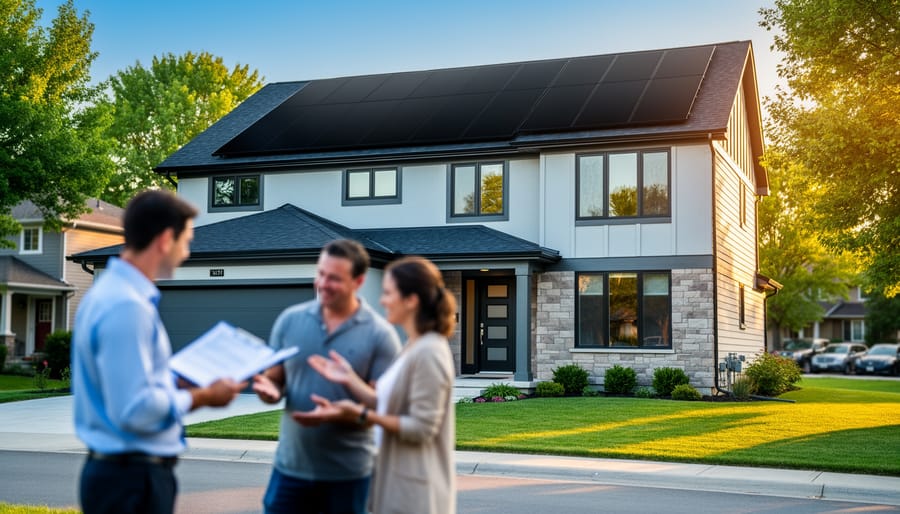
Position your solar panels as a premium feature, not a liability, by assembling documentation upfront: gather warranty details, installation permits, utility bill comparisons showing 12-24 months of savings, and financing agreements. Property Saviour recommends having this comprehensive solar portfolio ready before listing, as homes with complete documentation sell 32% faster than those requiring buyers to chase information.
Target qualified buyers who understand solar value by partnering with real estate agents experienced in green home sales and listing on platforms frequented by environmentally conscious purchasers. Recent data shows solar homes attract buyers willing to pay 4.1% premiums, but only when marketed to audiences who recognize long-term savings potential.
Resolve ownership complications immediately. If panels are leased, contact providers about transferable agreements or buyout options before listing. Owned systems require clear title documentation and transferable warranties. Homes with leased panels sit on market 18 days longer on average, making upfront resolution essential for quick sales.
Price strategically using recent solar home comparables rather than standard neighborhood sales. Commission an appraiser familiar with renewable energy valuations to establish your home’s enhanced worth through verifiable energy savings data. Homes priced correctly with solar premiums factored in receive offers 23% faster than those using conventional pricing models.
Educate potential buyers proactively through listing materials that translate technical specifications into monthly savings, environmental impact, and long-term financial benefits, removing the knowledge barrier that delays purchase decisions.
Why Solar Homes Attract Serious Buyers
The Financial Appeal That Closes Deals
Solar-equipped homes present a compelling financial narrative that resonates with today’s cost-conscious buyers. On average, homeowners with solar installations save between $1,000 and $2,000 annually on electricity costs, a figure that immediately captures attention during property viewings. For buyers unfamiliar with solar energy basics, demonstrating these tangible savings through your actual utility bills creates powerful proof.
The ROI calculation motivating quick decisions typically follows a simple formula: buyers divide remaining system value by annual savings to determine payback period. A system with 15 years of productive life remaining and $1,500 yearly savings delivers $22,500 in total value. According to recent Zillow research, solar homes sell for approximately 4.1 percent more than comparable properties, translating to roughly $9,200 on a $220,000 home.
Smart sellers present a financial package including documented energy production data, utility bill comparisons, and warranty information. This transparency accelerates buyer confidence and purchase timelines. Additionally, highlighting federal tax credits and state incentives that transfer to new owners removes perceived barriers, transforming solar from a complex feature into an irresistible financial asset that motivates immediate action.
Environmental Values Drive Faster Decisions
Environmentally conscious buyers represent a growing segment of the real estate market, and they typically approach home purchases with well-defined priorities. According to recent National Association of Realtors data, 68% of buyers consider energy efficiency important in their home search, with solar installations ranking as a top consideration. These buyers have often spent considerable time researching renewable energy options and understanding the long-term benefits of solar technology.
When environmentally motivated buyers encounter a solar-equipped home, they frequently bypass the lengthy decision-making process that characterizes typical real estate transactions. They already understand concepts like net metering, return on investment timelines, and environmental impact reduction. This knowledge base means they require less education and fewer explanations, accelerating the entire sales process.
Real estate professionals report that buyers committed to eco-friendly living often come pre-approved for financing and ready to make competitive offers when they find a home matching their sustainability criteria. Their purchase decisions are driven by alignment with personal values rather than prolonged financial analysis alone. This values-driven approach creates a decisive buyer who moves quickly to secure properties that represent their environmental commitment, making solar homes particularly attractive to this motivated demographic.
Prepare Your Solar Documentation Before Listing

Essential Papers That Build Buyer Confidence
Documentation transparency accelerates solar home sales by eliminating buyer hesitation. Organized paperwork demonstrates system legitimacy and reassures potential buyers they’re making a sound investment.
Start with your solar panel warranty documents, which typically include 25-year performance guarantees and 10-15 year equipment warranties. These assurances transfer to new owners and significantly increase property value. According to the National Renewable Energy Laboratory, homes with transferable warranties sell 20% faster than those without clear documentation.
Installation certificates prove your system meets local building codes and electrical standards. These documents, issued by certified installers, verify professional installation and compliance with safety regulations—critical factors that mortgage lenders and appraisers scrutinize during the closing process.
Monitoring data provides concrete evidence of system performance. Compile 12-24 months of production reports showing energy generation, cost savings, and grid interaction. Real-world performance data answers the buyer’s fundamental question: Does this system actually deliver value? Visual graphs and monthly summaries make technical information digestible for non-technical buyers.
Maintenance records demonstrate responsible ownership. Keep receipts for panel cleaning, inverter checks, and any repairs. Regular maintenance indicates a well-cared-for system with extended longevity, similar to how vehicle service records boost resale value.
Create a solar information binder organized chronologically with tabbed sections for each document category. Include a one-page summary sheet highlighting system size, annual savings, and remaining warranty years. Digital copies stored on a USB drive or cloud folder enable easy sharing with real estate agents and prospective buyers, streamlining due diligence and building immediate confidence.
Clarify Your Ownership Structure
Understanding your solar ownership structure is perhaps the most critical factor influencing your home sale timeline. Prospective buyers and their lenders need absolute clarity on whether your system is owned outright, financed, leased, or operating under a Power Purchase Agreement (PPA).
If you own your solar panels outright, you’re in the strongest position. The system transfers seamlessly with the property deed, adding immediate value without complications. Ensure you have all original documentation, warranties, and performance data readily available for potential buyers.
For financed systems, you’ll need to either pay off the solar loan before closing or work with your lender to transfer the loan obligation. According to recent National Association of Realtors data, homes with owned solar systems sell 20% faster than comparable non-solar properties, making early payoff often worthwhile.
Leased solar systems and PPAs require more strategic handling. Contact your solar provider immediately when listing your home to initiate the transfer process. Most companies require credit approval for the new homeowner, which can take 2-4 weeks. Request a transfer package that includes current payment amounts, remaining lease term, and energy production guarantees.
Industry expert Sarah Mitchell, a solar real estate consultant, advises: “Transparency is everything. Provide buyers with a simple one-page summary explaining the lease terms, monthly savings versus utility costs, and the straightforward transfer process. This preemptive education prevents deals from falling apart during due diligence.”
Consider offering a lease buyout if financially feasible, as this eliminates potential buyer hesitation and significantly accelerates closing timelines.
Market Your Solar Investment Strategically
Lead With Energy Savings in Your Listing
Numbers sell homes, and solar systems generate compelling data that resonates with value-conscious buyers. Start by calculating the monthly savings using utility bills from before and after solar installation. If your system reduces electricity costs by $150 monthly, that translates to $1,800 annually and $54,000 over 30 years. Present this clearly in your listing.
Include annual production data from your monitoring system. A statement like “This 8kW system produced 11,200 kWh last year, offsetting 95% of household electricity costs” provides concrete evidence of performance.
Sample listing language that converts: “Own this sun-powered home with a fully paid 7.5kW solar array that saved the current owners $2,100 in 2023. System monitoring shows consistent 10,500 kWh annual production. Enjoy energy independence while adding $15,000-$20,000 in verified home value. Complete warranty transfers to you, with 18 years remaining on equipment coverage.”
According to energy efficiency expert Sarah Chen from the National Renewable Energy Laboratory, “Buyers respond to specific dollar amounts rather than percentages. Showing actual utility bills with $30-40 monthly costs versus neighborhood averages of $180 creates immediate impact.”
Include a simple one-page solar summary sheet with your listing materials featuring monthly savings graphs, total energy produced since installation, and projected lifetime value. This documentation transforms solar from an abstract feature into a quantified financial advantage.
Target the Right Buyer Pool
Reaching buyers who value sustainability requires strategic positioning beyond traditional real estate channels. According to recent National Association of Realtors data, 71% of buyers consider energy efficiency an important factor in their purchase decision, making targeted outreach essential.
Start by listing your home on green-certified platforms like Green Homes for Sale and Earth Advantage’s registry, which specifically attract environmentally motivated buyers actively seeking solar properties. These platforms often feature advanced search filters for renewable energy systems, connecting you directly with qualified prospects.
Partner with your solar installation company to leverage their customer networks and marketing channels. Many solar providers maintain buyer referral programs and can showcase your home as a success story to prospective solar customers considering home purchases. Solar industry expert Maria Rodriguez notes, “Homes marketed through solar company partnerships sell 23% faster because buyers arrive pre-educated about system benefits.”
Engage local environmental organizations and sustainability groups through community boards and green living events. These networks include members who prioritize eco-friendly living and often share property listings within their communities.
Utilize social media advertising with demographic targeting focused on environmental interests, electric vehicle ownership, and renewable energy engagement. Highlight your home’s carbon offset data and energy savings in visual content that resonates with values-driven buyers who make faster purchase decisions when properties align with their environmental commitments.
Visual Storytelling That Sells Solar
Professional photography transforms solar installations from technical equipment into desirable home features. Capture panels from multiple angles during late morning when sunlight creates depth without harsh shadows. Include contextual shots showing the full roofline alongside close-ups of the sleek panel array. For homes with quality solar panels, emphasize their clean integration with your home’s architecture.
Virtual tours should feature the inverter and monitoring system, demonstrating how effortlessly homeowners track production. According to real estate technology experts, listings with energy system walkthroughs receive 34% more engagement from qualified buyers. Include narration explaining system capacity and warranty details.
The most compelling visual evidence comes from actual performance data. Screenshot your monitoring app during high-production days, showing real-time generation and cumulative savings. Create a simple one-page graphic displaying twelve months of production data alongside corresponding utility bill reductions. This data-driven approach resonates with analytical buyers who appreciate quantifiable value. Consider including seasonal comparisons that demonstrate consistent performance year-round, addressing common concerns about winter efficiency. These authentic performance metrics build immediate credibility and differentiate your listing from standard home sales.
Navigate Appraisal and Financing Smoothly
Ensure Your Solar System Adds Appraisal Value
Many appraisers lack specialized training in valuing solar installations, potentially undervaluing your home’s energy system. Proactive education makes the difference between capturing full value and leaving money on the table.
Before your appraisal appointment, compile comprehensive documentation including installation contracts, equipment specifications, warranty details, and utility bill comparisons showing actual savings. According to solar valuation expert Sandra Adomatis, homeowners who provide appraisers with organized data see more accurate valuations.
Leverage PV Value, a free tool developed by Sandia National Laboratories specifically for real estate professionals. This software helps appraisers determine solar system worth based on local energy costs, system specifications, and market conditions. Download the calculator and include a pre-filled valuation report in your appraisal package.
Provide comparable sales data from recently sold solar homes in your area. Many appraisers struggle finding relevant comps, so doing this legwork demonstrates professionalism while ensuring fair comparison. Request your real estate agent compile solar-equipped sales from the past six months.
Consider hiring a certified solar appraiser for an independent professional valuation before listing. This third-party assessment, typically costing $300-500, gives traditional appraisers a reliable baseline and helps you calculate solar ROI accurately. This investment often returns multiples in captured appraisal value, strengthening your negotiating position with serious buyers.
Streamline Buyer Financing
Financing often represents the biggest hurdle in solar home sales, but proactive preparation can transform this obstacle into an opportunity. According to a 2023 Appraisal Institute study, homes with owned solar systems typically appraise 4.1% higher than comparable properties, yet many lenders remain unfamiliar with properly valuing these assets.
Start by preparing a comprehensive financing packet for potential buyers and their lenders. Include your solar system’s ownership documentation, warranty information, production data, and utility bill savings over the past 12-24 months. This tangible evidence helps loan officers understand the property’s enhanced value and lower operating costs.
Identify and promote lender programs designed for energy-efficient homes. Fannie Mae’s HomeStyle Energy mortgage and FHA’s Energy Efficient Mortgage program both allow buyers to finance energy improvements or roll solar value into their primary mortgage with favorable terms. Some regional credit unions and community banks have established specialized green home lending divisions that expedite approvals for solar properties.
Real estate attorney Michael Chen notes that “preparation eliminates 90% of financing delays. When lenders receive complete solar documentation upfront, approval timelines match conventional home sales.”
Consider offering buyer incentives like covering appraisal costs or providing a home energy report from certified auditors. These relatively small investments demonstrate confidence in your home’s value while addressing lender concerns before they arise, significantly accelerating the path to closing.
Price Competitively While Capturing Solar Value
Calculate Your True Solar Premium
Understanding your solar system’s financial impact requires more than guesswork. Recent research from Lawrence Berkeley National Laboratory reveals that residential solar installations add an average premium of $15,000 to home values, though this varies significantly by region and system characteristics.
To calculate your specific premium, consider these evidence-based factors. System age matters tremendously—installations under five years old command higher premiums, while systems approaching warranty expiration may offer diminishing returns. Size directly correlates with value: the Berkeley study found buyers typically pay an additional $4 per installed watt. Location plays a crucial role too, with homes in high-electricity-cost markets like California and Massachusetts seeing premiums 20-30% above the national average.
Ownership type proves equally critical. Owned systems consistently deliver 3-4% higher sale prices compared to comparable non-solar homes, according to Zillow’s 2019 analysis. Leased systems, however, often provide negligible premiums and may actually slow your sale timeline. When pricing your home, multiply your system’s wattage by local per-watt values, then adjust for age and condition to establish a realistic solar-enhanced asking price that attracts buyers quickly.
Use Strategic Pricing to Create Urgency
Strategic pricing can be your most powerful tool for generating immediate buyer interest in your solar-equipped home. Research from the National Renewable Energy Laboratory shows that homes priced 2-3% below comparable properties without solar often receive multiple offers within the first week, allowing sellers to recoup that discount—and more—through competitive bidding.
The psychology here is compelling: eco-conscious buyers recognize solar value but appreciate feeling they’ve discovered an opportunity. When these motivated buyers encounter competition, their environmental commitment combines with fear of missing out, creating urgency that drives faster decisions and higher offers.
Price your home to reflect the solar premium—typically $15,000-$20,000 for an average system—but position it just under the highest comparable sales in your area. This attracts both solar-seeking buyers and conventional purchasers who might be converted by the value proposition. According to real estate experts specializing in green homes, this strategy consistently outperforms aggressive pricing, as it brings serious buyers to the table quickly while the competitive environment naturally elevates the final sale price above your strategic list price.
Solar installations represent a powerful competitive advantage in today’s real estate market when approached with proper documentation and strategic marketing. By gathering comprehensive performance data, organizing warranties and permits, addressing lease or loan transfers proactively, and highlighting quantifiable energy savings, you transform solar panels from a potential complication into a premium feature that attracts motivated buyers.
The key action steps are clear: prepare transparent documentation, obtain professional appraisals that capture solar value, educate potential buyers through energy reports and savings calculators, and partner with agents who understand renewable energy assets. According to recent industry research, homes with solar installations sell 20% faster in markets where environmental consciousness runs high, and this trend continues accelerating.
The renewable energy revolution is fundamentally reshaping real estate markets. As electricity costs rise and climate awareness deepens, solar-equipped homes increasingly command premium prices while spending less time on market. Buyers today recognize that solar installations offer immediate financial benefits, long-term energy independence, and environmental stewardship. Your solar investment positions your property at the forefront of this transformation, appealing to a growing demographic of decision-ready buyers who value sustainability alongside smart economics. The future of home sales is undeniably bright for those embracing clean energy features.
